
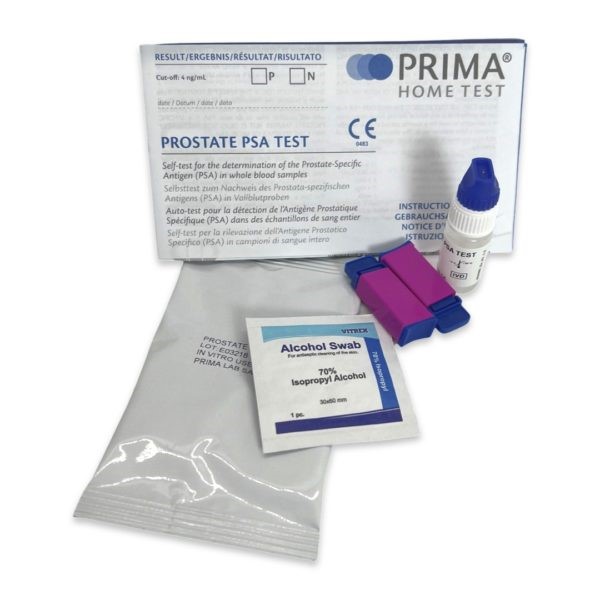
PRIMA PSA Testing Kit
This test measures prostate specific antigen (PSA) in a finger-prick blood sample, indicating whether the level is above or below 4 ng/mL — the threshold at which further investigation is commonly considered. PSA is produced by the prostate and can be raised for several reasons, including benign prostatic enlargement, infection, recent vigorous exercise or cycling, as well as prostate cancer. Because of this, PSA is used as a screening prompt rather than a diagnostic answer. The result develops in around ten minutes and everything needed is included.
Intended use
For men who want to check their PSA level at home, typically those over 50, or over 45 with a family history of prostate cancer.
This is a screening test intended to support, not replace, professional medical advice. Please consult a doctor about your results.
What your result will mean
Worth knowing before you test, not after.
Your PSA appears to be above 4 ng/mL. This is common and has many benign causes, but it should always be discussed with a GP, who can arrange a laboratory PSA test and examination.
Your PSA appears to be below 4 ng/mL. Some prostate cancers do not raise PSA, so this does not rule cancer out. Report any urinary symptoms to a GP regardless of this result.
If no line appears at C, the test has not run correctly. Contact us for a replacement.
Questions people ask
What can raise PSA other than cancer?
Quite a lot. An enlarged prostate, urinary infection, recent cycling, vigorous exercise and recent ejaculation can all raise PSA. This is why a raised result is a prompt to investigate rather than an answer.
What if the result is positive?
A positive screening result is not a diagnosis — it means further testing is worthwhile. Take the result to a GP, who will arrange a confirmatory laboratory test. Many people who get a positive screening result turn out not to have the condition, because screening tests are deliberately set to catch possible cases rather than to be certain. Finding out early almost always gives you more options, not fewer.
Should I avoid anything before testing?
Many guidelines suggest avoiding cycling, vigorous exercise and ejaculation for 48 hours beforehand, as each can temporarily raise PSA.
I'm nervous about testing at all. Is that normal?
Yes, and it's the most common reason people put testing off. It can help to know that a test only tells you something that is already true — it doesn't change your situation, it just gives you the chance to act on it. You can also test with someone you trust nearby, and you don't have to read the result alone.
Does the finger-prick hurt?
Most people describe it as a brief sharp scratch, similar to a diabetes blood glucose check. The lancet is spring-loaded so the depth is fixed and controlled. Warming your hands first and using the side of your fingertip rather than the pad usually makes it easier.
At what age should men consider PSA testing?
Testing is most commonly considered from age 50, or from 45 for men with a family history of prostate cancer or of Black African or Caribbean heritage, who are at higher risk.
How much blood do I actually need?
Usually a single drop — around one to two drops depending on the test. The kit includes a pipette to transfer it, so you don't need to be precise by eye.
What if I make a mistake doing the test?
The most common issue is not getting enough sample, which usually shows up as an invalid result with no control line. If that happens the test hasn't run correctly and the result shouldn't be interpreted — you'll need to order another test to get a valid result. Following the instructions in the pack carefully is the best way to avoid this.
Will the packaging show what I've ordered?
No. Everything is dispatched in plain outer packaging with nothing on the label indicating the contents. Your card statement shows only "Seradiag" and an order number, and our emails never name the tests you've bought.
Are these the same tests a clinic would use?
They are CE marked in-vitro diagnostic tests from established manufacturers, in many cases the same devices used in professional settings. The difference is usually the packaging and the instructions, which are written for self-testing rather than clinical use.
How accurate are the tests?
Accuracy figures are published on each product page, taken directly from the manufacturer's instructions for use. No rapid test is perfect: results can be affected by how and when the test is taken, and by individual biological factors. That is why every result — particularly an unexpected one — should be discussed with a healthcare professional.
Can I return a test if I change my mind?
Yes, if the seal is unbroken — within 14 days. Once a kit has been opened it can't be returned for hygiene reasons, which is a legal exception for sealed health products. Faulty, damaged or expired kits are always refunded, opened or not.
How quickly will it arrive?
Delivery options and timescales are shown at checkout. Orders placed before 2pm on a working day are dispatched the same day. If you need a result quickly, choose a faster delivery option at checkout.
Do I need to send anything to a laboratory?
No. These are self-contained rapid tests that you read yourself at home, usually within 5 to 15 minutes. Nothing is posted anywhere, and we never see or store your results.
Who are Seradiag?
Seradiag Ltd is a UK company (registered number 14428934) supplying CE marked diagnostic tests. If you have a question before ordering, email us — we would rather help you choose the right test than sell you the wrong one.